

Which Fish Are Considered Most Closely Related To Land Animals
| Tiktaalik Temporal range: Belatedly Devonian (Frasnian), Possible record in the Middle Devonian | |
|---|---|
 | |
| Tiktaalik in the Field Museum, Chicago | |
Scientific nomenclature  | |
| Kingdom: | Animalia |
| Phylum: | Chordata |
| Clade: | Stegocephalia |
| Genus: | † Tiktaalik Daeschler, Shubin & Jenkins, 2006 |
| Type species | |
| † Tiktaalik roseae Daeschler, Shubin & Jenkins, 2006 | |
Tiktaalik (; Inuktitut ᑎᒃᑖᓕᒃ [tiktaːlik]) is a monospecific genus of extinct sarcopterygian (lobe-finned fish) from the Late Devonian Period, about 375 Mya (million years ago), having many features akin to those of tetrapods (4-legged animals).[ane]
Unearthed in Chill Canada, Tiktaalik is a not-tetrapod osteoichthyes, consummate with scales and gills – merely it has a triangular, flattened caput and unusual, cleaver-shaped fins. Its fins take thin ray bones for paddling similar most fish, only they besides accept sturdy interior bones that would have allowed Tiktaalik to prop itself up in shallow water and utilise its limbs for support as most iv-legged animals exercise. Those fins and a suite of other characteristics fix Tiktaalik apart as something special; it has a combination of features that show the evolutionary transition between swimming fish and their descendants, the four-legged vertebrates – a clade which includes amphibians, reptiles, birds and mammals.[2]
This animal and similar animals may possibly be the mutual ancestors of the broad swath of all vertebrate terrestrial animate being: amphibians, reptiles, birds, and mammals.[3]
The first well-preserved Tiktaalik fossils were constitute in 2004 on Ellesmere Island in Nunavut, Canada. The discovery, fabricated by Edward B. Daeschler of the Academy of Natural Sciences, Neil H. Shubin from the University of Chicago, and Harvard University Professor Farish A. Jenkins Jr, was published in the April six, 2006, issue of Nature [1] and speedily recognized equally a transitional form.
Clarification [edit]

Tiktaalik provides insights on the features of the extinct closest relatives of the tetrapods. Unlike many previous, more fishlike transitional fossils, the "fins" of Tiktaalik have basic wrist basic and simple rays reminiscent of fingers. The homology of distal elements is uncertain; there have been suggestions that they are homologous to digits, although this is incompatible with the digital arch developmental model considering digits are supposed to exist postaxial structures, and merely iii of the (reconstructed) eight rays of Tiktaalik are postaxial.[four]
However, the proximal series can be directly compared to the ulnare and intermedium of tetrapods. The fin was conspicuously weight bearing, being attached to a massive shoulder with expanded scapular and coracoid elements and attached to the trunk armor, large muscular scars on the ventral surface of the humerus, and highly mobile distal joints. The bones of the forefins show large muscle facets, suggesting that the fin was both muscular and had the power to flex like a wrist articulation. These wrist-like features would have helped anchor the fauna to the lesser in fast moving current.[5] [6]

Skull showing spiracle holes higher up the eyes
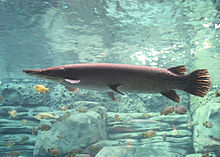
The alligator gar is an extant fish that bears some resemblance to Tiktaalik
Besides notable are the spiracles on the superlative of the head, which suggest the brute had primitive lungs likewise equally gills. This attribute would have been useful in shallow h2o, where higher water temperature would lower oxygen content. This development may have led to the evolution of a more robust ribcage, a central evolutionary trait of land-living creatures.[7] The more than robust ribcage of Tiktaalik would have helped back up the creature's body whatever time it ventured outside a fully aquatic habitat. Tiktaalik likewise lacked a feature that most fishes accept—bony plates in the gill expanse that restrict lateral head motility. This makes Tiktaalik the earliest known fish to have a neck, with the pectoral girdle dissever from the skull. This would give the creature more freedom in hunting casualty either on land or in the shallows.[vi]
Tiktaalik is sometimes compared to bloke (esp. Atractosteus spatula, the alligator gar) of the family Lepisosteidae, with whom information technology shares a number of characteristics:[8]
- diamond-shaped scale patterns common to the Crossopterygii class (in both species scales are rhombic, overlapping and tuberculated);
- teeth structured in 2 rows;
- both internal and external nostrils;
- tubular and streamlined torso;
- absence of anterior dorsal fin;
- broad, dorsoventrally compressed skull;
- paired frontal bones;
- marginal nares;
- subterminal mouth;
- lung-like organ.
Paleobiology [edit]

Tiktaalik generally had the characteristics of a lobe-finned fish, merely with forepart fins featuring arm-like skeletal structures more akin to those of a crocodile, including a shoulder, elbow, and wrist. The fossil discovered in 2004 did non include the rear fins and tail. It had rows[9] of abrupt teeth indicative of a predator fish, and its neck could motility independently of its body, which is not common in other fish (Tarrasius, Mandageria, placoderms,[10] [11] and extant seahorses being some exceptions; see too Lepidogalaxias and Channallabes apus [12]). The animal had a flat skull resembling a crocodile's; optics on top of its head; a neck and ribs like to those of tetrapods, with the ribs being used to support its body and aid in animate via lungs; well developed jaws suitable for catching casualty; and a small gill slit called a spiracle that, in more derived animals, became an ear.[13]
The fossils were found in the "Fram Formation", deposits of meandering stream systems well-nigh the Devonian equator, suggesting a benthic beast that lived on the bottom of shallow waters and perhaps fifty-fifty out of the water for short periods, with a skeleton indicating that it could support its body under the forcefulness of gravity whether in very shallow h2o or on state.[xiv] At that period, for the first time, deciduous plants were flourishing and annually shedding leaves into the water, attracting small casualty into warm oxygen-poor shallows that were difficult for larger fish to swim in.[7] The discoverers said that in all likelihood, Tiktaalik flexed its proto-limbs primarily on the floor of streams and may have pulled itself onto the shore for brief periods.[15] In 2014, the discovery of the fauna's pelvic girdle was appear; it was strongly built, indicating the animal could take used them for moving in shallow h2o and across mudflats.[16] Neil Shubin and Daeschler, the leaders of the team, take been searching Ellesmere Isle for fossils since 2000[5] [17]

Tiktaalik's discoverers believe the animal ventured onto state but as nowadays day mudskippers do, propping upwardly on their fins
We're making the hypothesis that this animal was specialized for living in shallow stream systems, mayhap swampy habitats, perhaps fifty-fifty to some of the ponds. And maybe occasionally, using its very specialized fins, for moving up overland. And that's what is specially important here. The animal is developing features which will somewhen allow animals to exploit country.[18]
Classification and evolution [edit]

Tiktaalik roseae is the only species classified under the genus. Tiktaalik lived approximately 375 million years ago. Information technology is representative of the transition between non-tetrapod vertebrates (fish) such as Panderichthys, known from fossils 380 1000000 years onetime, and early on tetrapods such as Acanthostega and Ichthyostega, known from fossils about 365 million years old. Its mixture of primitive fish and derived tetrapod characteristics led i of its discoverers, Neil Shubin, to characterize Tiktaalik as a "fishapod".[5] [19]
Tiktaalik is a transitional fossil; it is to tetrapods what Archaeopteryx is to birds, troodonts and dromaeosaurids. While it may be that neither is ancestor to whatsoever living animal, they serve every bit evidence that intermediates between very different types of vertebrates did once exist. The mixture of both fish and tetrapod characteristics establish in Tiktaalik include these traits:
- Fish
- fish gills
- fish scales
- fish fins
- "Fishapod"
- half-fish, half-tetrapod limb basic and joints, including a functional wrist joint and radiating, fish-like fins instead of toes
- one-half-fish, one-half-tetrapod ear region
- Tetrapod
- tetrapod rib bones
- tetrapod mobile neck with split pectoral girdle
- tetrapod lungs
Phylogenetic position [edit]
2006 – 2010 [edit]
The phylogenetic analysis by Daeschler et al. placed Tiktaalik as a sis taxon to Elpistostege and directly higher up Panderichthys preceded by Eusthenopteron. Tiktaalik was thus inserted beneath Acanthostega and Ichthyostega as a transitional course[20] and a truthful "missing link".[21]
Such order of the phylogenetic tree was initially adopted by other experts, about notably by Per Ahlberg and Jennifer Clack.[22] Withal, it was questioned in a 2008 paper by Boisvert et al., who noted that Panderichthys, due to its more derived distal portion, might exist closer to tetrapods than Tiktaalik or even that it was convergent with tetrapods.[23] Ahlberg, co-author of the study, considered the possibility of Tiktaalik's fin having been "an evolutionary render to a more archaic form."[24]
2010 – now [edit]


In January 2010, a group of paleontologists including Ahlberg published a paper[25] accompanied past all-encompassing supplementary fabric[26] (discussed besides in a Nature documentary[27] [28]) which showed that the start tetrapods appeared long before Tiktaalik and other elpistostegids. Their conclusions were based on numerous trackways (esp. Muz. PGI 1728.II.16) and individual footprints (esp. Muz. PGI 1728.2.i) discovered at the Zachełmie quarry in the Holy Cross Mountains (Poland). A tetrapod origin of those tracks was suggested based on:
- singled-out digits and limb morphology;
- trackways reflecting quadrupedal gait and diagonal walk;
- no trunk or tail drag marks;
- very wide stride in relation to torso length (much beyond that of Tiktaalik or any other fish);
- various size footprints with some unusually big (upwardly to 26 cm wide) indicating body lengths of over two.five thou.
Rails-bearing layers were assigned to the lower-middle Eifelian based on conodont index fossil samples (costatus Zone) and "previous biostratigraphic information obtained from the underlying and overlying strata"[25] with subsequent studies confirming this dating.[29] [30] [31]

Zachełmie trackmakers predate not just ichthyostegids and elpistostegids (including Tiktaalik) but too a number of tetrapodomorph fish which until 2010 were unanimously considered ancestors of tetrapods.
Both Tiktaalik's discoverers were skeptical about the Zachelmie trackways. Daeschler said that trace show was not enough for him to modify the theory of tetrapod evolution,[32] while Shubin argued that Tiktaalik could have produced very like footprints[33] (in a afterwards written report Shubin expressed a significantly modified stance that some of the Zachelmie footprints, those which lacked digits, may accept been made past walking fish[34]). However, Ahlberg insisted that those tracks could not have possibly been formed either by natural processes or by transitional species such as Tiktaalik or Panderichthys.[25] [35] Instead, the authors of the publication suggested ichthyostegalians as trackmakers, based on available pes morphology of those animals.[25] However, a paper published in 2015 that undertook a critical review of Devonian tetrapod footprints called into question the designation of the Zachelmie marks and instead suggested an origin every bit fish nests/feeding traces.[36] An earlier study in 2012 indicated that Zachelmie trackmakers were even more advanced than Ichthyostega in terms of quadrupedalism.[37] Grzegorz Niedźwiedzki'due south reconstruction of one of the trackmakers was identical to that of Tulerpeton.[38] [39]
Narkiewicz, co-author of the article on the Zachelmie trackways, claimed that the Shine "discovery has disproved the theory that elpistostegids were the ancestors of tetrapods",[40] a notion partially shared by Philippe Janvier.[41] There have been a number of new hypotheses suggested as to a possible origin and phylogenetic position of the elpistostegids (including Tiktaalik):
- their phylogenetic position remains unchanged and the footprints constitute in the Holy Cantankerous Mountains are attributed to tetrapods but as a consequence there are at to the lowest degree six long ghost lineages separating Zachelmie trackmakers from various elpistostegalian and ichthyostegalian species;[25]
- they were "tardily-surviving relics rather than direct transitional forms";[38] [42]
- they were "an evolutionary dead-end";[43]
- they were a result of convergent or parallel evolution so that apomorphies and hitting anatomical similarities found in both digited tetrapods and elpistostegalians evolved at least twice.[44] [45] [46]
Convergency is considered responsible for uniquely tetrapod features found also in other non-elpistostegalian fish from the menses like Sauripterus (finger-like jointed distal radial bones)[47] [48] or Tarrasius (tetrapod-like spine with five axial regions).[49]
Estimates published subsequently the discovery of Zachelmie tracks suggested that digited tetrapods may have appeared every bit early as 427.4 Ma agone and questioned attempts to read absolute timing of evolutionary events in early tetrapod evolution from stratigraphy.[45]
Until more information get available, the phylogenetic position of Tiktaalik and other elpistostegids remains uncertain.
Discovery [edit]

Discovery site of Tiktaalik fossils
In 2004, three fossilized Tiktaalik skeletons were discovered in the Tardily Devonian fluvial Fram Formation on Ellesmere Island, Nunavut, in northern Canada.[50] [51] Estimated ages reported at 375 MYA, 379 MYA, and 383 MYA. At the time of the species' existence, Ellesmere Isle was role of the continent Laurentia (modernistic eastern N America and Greenland),[52] which was centered on the equator and had a warm climate. When discovered, one of the skulls was found sticking out of a cliff. Upon further inspection, the fossil was found to be in excellent condition for a 375-meg-yr-old specimen.[5] [17]
The discovery by Daeschler, Shubin, and Jenkins was published in the April half dozen, 2006, issue of Nature [1] and quickly recognized as a transitional class. Jennifer A. Clack, a Cambridge University skillful on tetrapod evolution, said of Tiktaalik, "It's ane of those things you can indicate to and say, 'I told you lot this would exist,' and at that place information technology is."[6]

Neil Shubin, i of the paleontologists who discovered Tiktaalik, belongings a cast of its skull
After five years of digging on Ellesmere Isle, in the far north of Nunavut, they hit pay dirt: a collection of several fish so beautifully preserved that their skeletons were still intact. As Shubin's team studied the species they saw to their excitement that it was exactly the missing intermediate they were looking for. 'We plant something that really split the departure right down the middle,' says Daeschler.
— [53]
The name Tiktaalik is an Inuktitut word meaning "large freshwater fish".[three] The "fishapod" genus received this proper noun later on a suggestion by Inuit elders of Canada's Nunavut Territory, where the fossil was discovered.[52] The specific proper noun roseae cryptically honours an anonymous donor.[54] Taking a detailed look at the internal head skeleton of Tiktaalik roseae, in the October xvi, 2008, issue of Nature,[55] researchers show how Tiktaalik was gaining structures that could allow it to back up itself on solid ground and breathe air, a key intermediate footstep in the transformation of the skull that accompanied the shift to life on country past our distant ancestors.[56]
Cultural significance [edit]
Internet users have altered an analogy of Tiktaalik by artist Zina Deretsky to create memes.[57] The images more often than not humorously criticize Tiktaalik for its evolutionary adaptations, construing them as playing a critical role in the chain of events that would eventually lead to all man suffering.[57]
See also [edit]
- Walking fish
- Alligator gar
- Amphibious fish
- Spotted handfish
Other lobe-finned fish plant in fossils from the Devonian Period:
- Coelacanth
- Eusthenopteron
- Gogonasus
- Ichthyostega
- Panderichthys
References [edit]
- ^ a b c Edward B. Daeschler, Neil H. Shubin and Farish A. Jenkins Jr. (half dozen April 2006). "A Devonian tetrapod-like fish and the evolution of the tetrapod body plan". Nature. 440 (7085): 757–763. Bibcode:2006Natur.440..757D. doi:10.1038/nature04639. PMID 16598249.
- ^ "What has the head of a crocodile and the gills of a fish?". evolution.berkeley.edu. Archived from the original on 2018-06-12. Retrieved 2018-06-06 .
- ^ a b Shubin, Neil (2008). Your Inner Fish: A Journey into the 3.v-Billion-Twelvemonth History of the Human Body. New York: University of Chicago Press. ISBN9780375424472.
- ^ Laurin Grand (2006). "Scanty show and changing opinions well-nigh evolving appendages". Zoologica Scripta. 35 (6): 667–668. doi:ten.1111/zsc.2006.35.issue-six.
- ^ a b c d Shubin, Neil (2008). Your Inner Fish. Pantheon. ISBN978-0-375-42447-2.
- ^ a b c Holmes, Bob (2007). "Meet Your ancestor, the Fish that crawled". New Scientist. Archived from the original on 2016-04-13. Retrieved 2007-02-07 .
- ^ a b Jennifer A. Ballyhoo, Scientific American, Getting a Leg Up on Land Archived 2013-12-07 at the Wayback Machine November 21, 2005.
- ^ Spitzer, Mark (2010). Season of the Gar: Adventures in Pursuit of America's Most Misunderstood Fish. University of Arkansas Press. pp. 65–66. ISBN978-1-55728-929-2. Archived from the original on 2014-01-07. Retrieved 2016-10-29 .
- ^ "Fossil Suggests Missing Link From Fish to Land". NPR (National Public Radio). Archived from the original on 2006-10-13. Retrieved 2006-11-27 .
- ^ K. Trinajstic et al. (12 July 2013). "Fossil Musculature of the Most Primitive Jawed Vertebrates". Science. 341 (6142): 160–164. Bibcode:2013Sci...341..160T. doi:10.1126/science.1237275. PMID 23765280. S2CID 39468073.
{{cite periodical}}: CS1 maint: uses authors parameter (link) - ^ "Primitive fish could nod but non milk shake its head: Ancient fossils reveal surprises about early vertebrate necks, abdominal muscles". Scientific discipline News. June 13, 2013. Archived from the original on December fifteen, 2013. Retrieved Dec 14, 2013.
- ^ Sam Van Wassenbergh; Anthony Herrel; Dominique Adriaens; Frank Huysentruyt; Stijn Devaere & Peter Aerts (13 April 2006). "Evolution: A catfish that can strike its prey on land". Nature. 440 (7086): 881. Bibcode:2006Natur.440..881V. doi:10.1038/440881a. PMID 16612372. S2CID 4423295.
- ^ Dalton, King (2006). "The fish that crawled out of the h2o". Nature: news060403–7. doi:10.1038/news060403-vii. S2CID 129031187. Archived from the original on 2006-04-eleven. Retrieved 2006-04-06 .
- ^ The Academy of Natural Sciences, Philadelphia, press release Apr 3, 2006. (doc)
- ^ Neil H. Shubin, Edward B. Daeschler and Farish A. Jenkins Jr (6 April 2006). "The pectoral fin of Tiktaalik roseae and the origin of the tetrapod limb". Nature. 440 (7085): 764–771. Bibcode:2006Natur.440..764S. doi:10.1038/nature04637. PMID 16598250. S2CID 4412895.
- ^ Shubin, Due north. H.; Daeschler, East. B.; Jenkins, F. A. (2014). "Pelvic girdle and fin of Tiktaalik roseae". Proceedings of the National Academy of Sciences. 111 (3): 893–899. Bibcode:2014PNAS..111..893S. doi:10.1073/pnas.1322559111. PMC3903263. PMID 24449831.
- ^ a b Peterson, Britt (April 5, 2006). "An Evolutionary Finding". Seed. Archived from the original on Apr 11, 2006. Retrieved April 5, 2006.
{{cite news}}: CS1 maint: unfit URL (link) - ^ NewsHour, Fossil Discovery Archived 2014-01-22 at the Wayback Machine, April 6, 2006.
- ^ John Noble Wilford, The New York Times, Scientists Call Fish Fossil the Missing Link Archived 2017-xi-fifteen at the Wayback Machine, Apr. 5, 2006.
- ^ Daeschler, Edward B.; Shubin, Neil H.; Jenkins, Farish A. Jr (6 April 2006). "A Devonian tetrapod-like fish and the evolution of the tetrapod torso plan" (PDF). Nature. 440 (7085): 757–763. Bibcode:2006Natur.440..757D. doi:10.1038/nature04639. PMID 16598249. S2CID 4413217. Archived (PDF) from the original on 12 February 2015. Retrieved 24 January 2015.
- ^ Rex Dalton (5 Apr 2006). "The fish that crawled out of the water". Nature. doi:10.1038/news060403-7. Archived from the original on 24 January 2015. Retrieved 24 Jan 2015.
- ^ Ahlberg, Per Erik; Clack, Jennifer A. (half-dozen April 2006). "A firm stride from water to land". Nature. 440 (7085): 747–749. Bibcode:2006Natur.440..747A. doi:10.1038/440747a. PMID 16598240. S2CID 4392361.
- ^ Boisvert, Catherine A.; Mark-Kurik, Elga; Ahlberg, Per E. (four December 2008). "The pectoral fin of Panderichthys and the origin of digits". Nature. 456 (7222): 636–638. Bibcode:2008Natur.456..636B. doi:x.1038/nature07339. PMID 18806778. S2CID 2588617. Archived from the original on four January 2014. Retrieved 24 Jan 2015.
Given that recent phylogenies consistently place Panderichthys below Tiktaalik in the tetrapod stem grouping, information technology is surprising to discover that its pectoral fin skeleton is more limb-similar than that of its supposedly more than derived relative. [...] It is difficult to say whether this grapheme distribution implies that Tiktaalik is autapomorphic, that Panderichthys and tetrapods are convergent, or that Panderichthys is closer to tetrapods than Tiktaalik.
- ^ Ker Than (September 24, 2008). "Ancient Fish Had Archaic Fingers, Toes". National Geographic News. National Geographic Gild. Archived from the original on September 27, 2008.
Curiously, the radial bones of Panderichthys are more finger-like than those of Tiktaalik, a fish with stubby leg-like limbs that lived about 5 one thousand thousand years afterwards. Many scientists regard Tiktaalik as a "missing link": the crucial transitional animal betwixt fish and the first tetrapods. I possibility, Ahlberg said, is that finger development took a pace backward with Tiktaalik, and that Tiktaalik's fins represented an evolutionary return to a more primitive form.
- ^ a b c d e Niedźwiedzki, Grzegorz; Szrek, Piotr; Narkiewicz, Katarzyna; Narkiewicz, Marek; Ahlberg, Per E. (7 Jan 2010). "Tetrapod trackways from the early Middle Devonian Flow of Poland". Nature. 463 (7277): 43–48. Bibcode:2010Natur.463...43N. doi:10.1038/nature08623. PMID 20054388. S2CID 4428903.
- ^ Niedźwiedzki, Grzegorz; Szrek, Piotr; Narkiewicz, Katarzyna; Narkiewicz, Marek; Ahlberg, Per Due east. (2010). "Tetrapod trackways from the early Middle Devonian Period of Poland. Supplementary data". Nature. 463 (7277): 43–8. Bibcode:2010Natur.463...43N. doi:10.1038/nature08623. PMID 20054388. S2CID 4428903.
- ^ Walking with tetrapods. Nature. January 6, 2010. Archived from the original (FLV) on December 20, 2014.
- ^ Jonathan Amos (half dozen January 2010). "Fossil tracks record 'oldest land-walkers'". BBC. Archived from the original on January seven, 2010.
- ^ Narkiewicz, Katarzyna; Narkiewicz, Marek (1 March 2010). "Mid Devonian carbonate platform development in the Holy Cross Mts. expanse (central Poland): new constraints from the conodont Bipennatus fauna". Neues Jahrbuch für Geologie und Paläontologie - Abhandlungen. 255 (3): 287–300. doi:x.1127/0077-7749/2009/0025.
- ^ Niedźwiedzki, Grzegorz; Narkiewicz, Marek; Szrek, Piotr (2014). "The age of the oldest tetrapod tracks from Zachełmie, Poland". Bulletin of Geosciences. 89 (three): 593–606. Archived from the original on 2015-05-xi. Retrieved 2015-01-24 .
- ^ Narkiewicz, Katarzyna; Narkiewicz, Marek (January 2015). "Middle Devonian invertebrate trace fossils from the marginal marine carbonates of the Zachełmie tetrapod tracksite, Holy Cross Mountains, Poland". Lethaia. 48 (1): 10–12. doi:10.1111/let.12083.
- ^ "Trace evidence is not enough for me to change my mind almost accepted theories on tetrapod evolution" – Daeschler every bit quoted in Rex Dalton (January half-dozen, 2010). "Discovery pushes back date of first four-legged animate being". Nature: news.2010.1. doi:ten.1038/news.2010.ane. Archived from the original on March 8, 2014. "I am non set up to discard the established epitome for the fish-tetrapod transition" – Daeschler as quoted in Jef Akst (January 6, 2010). "Tetrapods' old age revealed". The Scientist. Archived from the original on March 4, 2016. Retrieved November 10, 2019. "With all respect to the scientists involved in this study, there may be other explanations for these suggestive tracks." – Daeschler every bit quoted in Dan Vergano (January 6, 2010). "Four-legged finding muddies paleontological waters". USA Today. Archived from the original on December 24, 2014.
- ^ [Neil Shubin] says that a model of Tiktaalik's skeleton would produce a print much like the one in the paper if it's mushed into sand, and unlike consistencies or angles would produce an even closer friction match. He adds, "At that place is naught in Tiktaalik's described beefcake that suggests information technology didn't have a pace." in Ed Yong (January 6, 2010). "Fossil tracks push back the invasion of state past eighteen million years". Find. Archived from the original on May 16, 2010.
- ^ King, Heather Thou.; Shubin, Neil H.; Coates, Michael I.; Hale, Melina East. (December 27, 2011). "Behavioral show for the evolution of walking and bounding earlier terrestriality in sarcopterygian fishes". PNAS. 108 (52): 21146–21151. Bibcode:2011PNAS..10821146K. doi:ten.1073/pnas.1118669109. PMC3248479. PMID 22160688.
Information technology follows that the attribution of some of the nondigited Devonian fossil trackways to limbed tetrapods may need to exist revisited.
- ^ "You can see anatomical details consistent with a footprint, including sediments displaced by a foot coming downwardly", "There is no way these could be formed by a natural procedure." - Ahlberg equally quoted in Rex Dalton (Jan half dozen, 2010). "Discovery pushes dorsum date of start 4-legged creature". Nature: news.2010.i. doi:10.1038/news.2010.1. Archived from the original on March 8, 2014.
- ^ Lucas, Spencer G. (2015). "Thinopus and a Critical Review of Devonian Tetrapod Footprints" (PDF). Ichnos. 22 (3–four): 136–154. doi:x.1080/10420940.2015.1063491. S2CID 130053031.
- ^ Pierce, Stephanie Due east.; Clack, Jennifer A.; Hutchinson, John R. (28 June 2012). "Three-dimensional limb joint mobility in the early tetrapod Ichthyostega" (PDF). Nature. 486 (7404): 523–526. Bibcode:2012Natur.486..523P. doi:10.1038/nature11124. PMID 22722854. S2CID 3127857.
- ^ a b Niedźwiedzki, Grzegorz; Szrek, Piotr (2010). "Way to Go!" (PDF). Academia. 2 (26): 28–31. ISSN 1731-7401. OCLC 786293607. Archived from the original (PDF) on January 19, 2015.
- ^ The 2007 creative restoration of Tulerpeton past Dmitry Bogdanov bachelor at Wikimedia is virtually identical to the 2008 rendering of a Zachelmie trackmaker by Grzegorz Niedźwiedzki.
- ^ Due west.Ż. (Feb 4, 2010). "A Creature That Time Forgot". The Warsaw Voice. Warsaw. Archived from the original on Dec 22, 2014. ; "Due west Polsce odkryto ślady najstarszych kopalnych czworonogów" [Oldest tetrapod fossil footprints discovered in Poland]. Science & Scholarship in Poland (Polish Press Bureau) (in Polish). Warsaw. January vii, 2010. Archived from the original on December 22, 2014.
- ^ "Nosotros now have to invent a common ancestor to the tetrapods and elpistostegids." – Janvier as quoted in Karen McVeigh (January vi, 2010). "Footprints show tetrapods walked on land 18m years earlier than thought". The Guardian. London. Archived from the original on March ii, 2014.
- ^ Editor's summary (7 Jan 2010). "Four feet in the past: trackways pre-appointment earliest body fossils". Nature. 463 (7277): forty–ane. Bibcode:2010Natur.463...40J. doi:10.1038/463040a. PMID 20054387. S2CID 447958. Archived from the original on November iii, 2012.
{{cite journal}}: CS1 maint: uses authors parameter (link) - ^ "Ancient Four-Legged Beasts Leave Their Mark". Science. 6 January 2010. Archived from the original on September 30, 2013.
- ^ Janvier, Philippe; Clément, Gaël (7 January 2010). "Muddy tetrapod origins". Nature. 463 (7277): forty–41. Bibcode:2010Natur.463...40J. doi:10.1038/463040a. PMID 20054387. S2CID 447958.
- ^ a b Friedman, Matt; Brazeau, Martin D. (7 Feb 2011). "Sequences, stratigraphy and scenarios: what tin can nosotros say about the fossil tape of the earliest tetrapods?". Proceedings of the Royal Society B. 278 (1704): 432–439. doi:x.1098/rspb.2010.1321. PMC3013411. PMID 20739322.
- ^ Gee, Henry (January 6, 2010). "Kickoff Ground". SciLogs. Archived from the original on Dec 22, 2014.
It is possible that the close similarity between elpistostegids and tetrapods might have been the result of evolutionary convergence. The common ancestor of elpistostegids and tetrapods wouldn't have to take looked similar Tiktaalik – information technology could accept been a more undifferentiated, tetrapodomorph fish. Elpistostegids and tetrapodomorphs, each following their own paths, grew to await more than and more similar 1 other.
- ^ Daeschler, Edward B.; Shubin, Neil (viii Jan 1998). "Fish with fingers?". Nature. 391 (6663): 133. Bibcode:1998Natur.391..133D. doi:x.1038/34317. S2CID 4386457.
- ^ Davis, Marcus C.; Shubin, Neil; Daeschler, Edward B. (2004). "A new specimen of Sauripterus taylori (Sarcopterygii, Osteichthyes) from the Famennian Catskill Formation of North America". Journal of Vertebrate Paleontology. 24 (1): 26–40. doi:10.1671/1920-iii. S2CID 128815066.
- ^ Sallan, Lauren Cole (22 Baronial 2012). "Tetrapod-like axial regionalization in an early ray-finned fish". Proceedings of the Royal Society B. 279 (1741): 3264–3271. doi:10.1098/rspb.2012.0784. PMC3385743. PMID 22628471.
- ^ Gorner, Peter (2006-04-05). "Fossil could exist fish-to-land link". Chicago Tribune.
- ^ Easton, John (2008-ten-23). "Tiktaalik's internal anatomy explains evolutionary shift from water to state". University of Chicago Chronicle. University of Chicago. 28 (3). Archived from the original on 2012-04-07. Retrieved 2009-07-nineteen .
- ^ a b Spotts, Peter (Apr 6, 2006). "Fossil fills gap in motility from bounding main to country". The Christian Science Monitor. Archived from the original on April half-dozen, 2006. Retrieved 2006-04-05 .
- ^ Holmes, Bob (5 April 2006). "Commencement fossil of fish that crawled onto land discovered". New Scientist News. Archived from the original on 6 April 2006. Retrieved 2006-04-07 .
- ^ Coyne, Jerry (2009). Why Development is True. Viking. ISBN978-0-670-02053-9. Archived from the original on 2019-x-07. Retrieved 2019-09-03 .
- ^ Jason P. Downs, Edward B. Daeschler, Farish A. Jenkins & Neil H. Shubin (16 October 2008). "The cranial endoskeleton of Tiktaalik roseae". Nature. 455 (7215): 925–929. Bibcode:2008Natur.455..925D. doi:ten.1038/nature07189. PMID 18923515. S2CID 4411801.
{{cite journal}}: CS1 maint: multiple names: authors listing (link) - ^ "Fishapod" Reveals Origins of Head and Cervix Structures of First Land Animals Archived 2008-x-xix at the Wayback Motorcar Newswise, Retrieved on October 15, 2008.
- ^ a b Imbler, Sabrina (29 April 2022). "Started Out every bit a Fish. How Did It End Upwards Like This?". The New York Times . Retrieved 29 April 2022.
External links [edit]
 | Wikiquote has quotations related to Tiktaalik . |
 | Wikimedia Commons has media related to Tiktaalik. |
- University of Chicago website dedicated to the discovery
- Interview with Neil Shubin on The Inoculated Mind, February 12, 2008.
- Interview with Neil Shubin on Tech Nation where he discusses the discovery of the Tiktaalik, February xiv, 2008.
- Lecture (presentation) by Neil Shubin about the discovery of Tiktaalik on YouTube
- Fishapod stars in music video, YouTube. Accessed on December 27, 2008.
- Finding Tiktaalik: Interview with Neil Shubin, Royal Institution video, February 2013
- A today's fish with tetrapod anatomy, able to motion like an early tetrapod – Cryptotora thamicola
Source: https://en.wikipedia.org/wiki/Tiktaalik
Posted by: clementsmadmily.blogspot.com
0 Response to "Which Fish Are Considered Most Closely Related To Land Animals"
Post a Comment